(8-10 servings)
Last month I became a member of the
Daring Kitchen, and by the end of the month I signed up for Daring Bakers. I may sign up for Daring Cooks as well at some point.
Each month recipes are revealed and then over
2000 bakers/cooks from around the world create one of those recipes in their kitchens. Substitutions are only allowed for such things as food allergies/intolerances or ingredients which are unavailable in certain regions.
Looking through the photos and comments members send in of their resulting recipe is quite intriguing; so many interpretations of the same thing. It's really quite wonderful, and what prompted me to join and give it a try.
This month's baker challenge was hosted by Jennifer from
Chocolate Shavings and she proposed an Orange Tian, a dessert she had made for the first time a few months earlier at a cooking school in France.
We made everything from scratch, including the marmalade, and the finished dessert was quite tasty.
I decided not to mess around with cookie cutters because I don't have enough. I used a 9" spring-form instead which turned out to be a challenge. Although I left the dessert in the freezer for twice the amount of time, it clearly wasn't enough. After I carefully loosened the edges and inverted it onto the cake plate, it didn't hold it's shape. I nearly died laughing. If I make this again, I might increase the amount of gelatin to 2 teaspoons and I'll definitely leave it in the freezer longer.
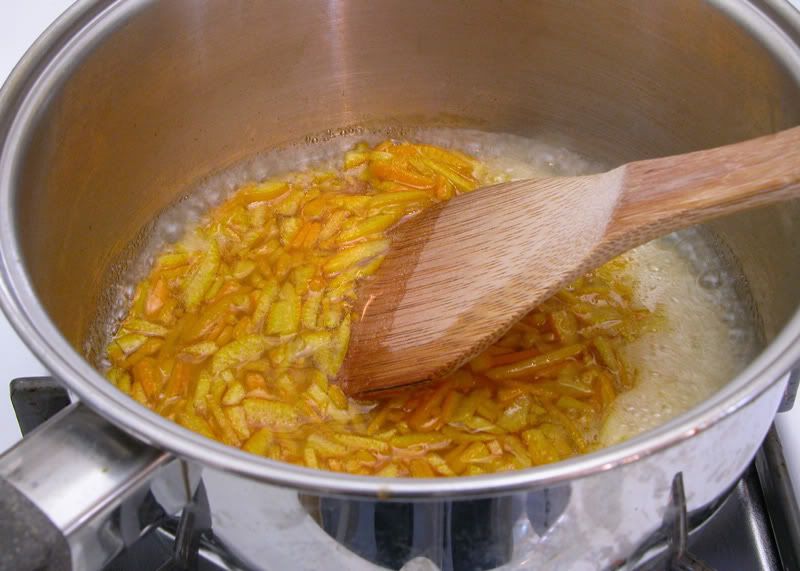
The only changes I made (I also used one grapefruit for colour) was for the marmalade. I didn't bother with the pectin and the mixture gelled just fine without it. It was so delicious I regretted not making more of it. The recipe calls for the peel of 1 orange, and I used 3 (for a little extra) when I should have used up the peels from all of the oranges. There's always a next time.
Needless to say, I'm really looking forward to the next challenge.
Below, I have copied the recipes we were given:
Recipe Source: Recipe slightly adapted from Alain Ducasse‘s Cooking School in Paris, France
For the Pate Sablee:Ingredients U.S. Imperial Metric Instructions for Ingredients2 medium-sized egg yolks at room temperaturegranulated sugar 6 tablespoons + 1 teaspoon; 2.8 oz; 80 gramsvanilla extract ½ teaspoonUnsalted butter ¼ cup + 3 tablespoons; 3.5 oz; 100 grams ice cold, cubedSalt 1/3 teaspoon; 2 gramsAll-purpose flour 1.5 cup + 2 tablespoons; 7 oz; 200 gramsbaking powder 1 teaspoon ; 4 grams Directions:Put the flour, baking powder, ice cold cubed butter and salt in a food processor fitted with a steel blade.
In a separate bowl, add the eggs yolks, vanilla extract and sugar and beat with a whisk until the mixture is pale. Pour the egg mixture in the food processor.
Process until the dough just comes together. If you find that the dough is still a little too crumbly to come together, add a couple drops of water and process again to form a homogenous ball of dough. Form into a disc, cover with plastic wrap and leave to rest in the fridge for 30 minutes.
Preheat your oven to 350 degree Fahrenheit.
Roll out the dough onto a lightly floured surface until you obtain a ¼ inch thick circle.
Using your cookie cutter, cut out circles of dough and place on a parchment (or silicone) lined baking sheet. Bake for 20 minutes or until the circles of dough are just golden.
For the Marmalade:Ingredients U.S. Imperial Metric Instructions for IngredientsFreshly pressed orange juice ¼ cup + 3 tablespoons; 3.5 oz; 100 grams1 large orange used to make orange slicescold water to cook the orange slicespectin 5 gramsgranulated sugar: use the same weight as the weight of orange slices once they are cookedFinely slice the orange. Place the orange slices in a medium-sized pot filled with cold water. Simmer for about 10 minutes, discard the water, re-fill with cold water and blanch the oranges for another 10 minutes.
Blanch the orange slices 3 times. This process removes the bitterness from the orange peel, so it is essential to use a new batch of cold water every time when you blanch the slices.
Once blanched 3 times, drain the slices and let them cool.
Once they are cool enough to handle, finely mince them (using a knife or a food processor).
Weigh the slices and use the same amount of granulated sugar . If you don’t have a scale, you can place the slices in a cup measurer and use the same amount of sugar.
In a pot over medium heat, add the minced orange slices, the sugar you just weighed, the orange juice and the pectin. Cook until the mixture reaches a jam consistency (10-15 minutes).
Transfer to a bowl, cover with plastic wrap and put in the fridge.
For the Orange Segments:For this step you will need 8 oranges.Cut the oranges into segments over a shallow bowl and make sure to keep the juice. Add the segments to the bowl with the juice.
[See YouTube video in the References section below for additional information on segmenting oranges.]
For the Caramel:Ingredients U.S. Metric Imperial Instructions for Ingredientsgranulated sugar 1 cup; 7 oz; 200 gramsorange juice 1.5 cups + 2 tablespoons; 14 oz; 400 grams Place the sugar in a pan on medium heat and begin heating it.
Once the sugar starts to bubble and foam, slowly add the orange juice. As soon as the mixture starts boiling, remove from the heat and pour half of the mixture over the orange segments.
Reserve the other half of the caramel mixture in a small bowl — you will use this later to spoon over the finished dessert. When the dessert is assembled and setting in the freezer, heat the kept caramel sauce in a small saucepan over low heat until it thickens and just coats the back of a spoon (about 10 minutes). You can then spoon it over the orange tians.
[Tip: Be very careful when making the caramel — if you have never made caramel before, I would suggest making this step while you don’t have to worry about anything else. Bubbling sugar is extremely, extremely hot, so make sure you have a bowl of ice cold water in the kitchen in case anyone gets burnt!]
For the Whipped Cream:Ingredients U.S. Metric Imperial Instructions for Ingredientsheavy whipping cream 1 cup; 7 oz; 200 grams3 tablespoons of hot water1 tsp Gelatine1 tablespoon of confectioner's sugarorange marmalade (see recipe above) 1 tablespoon In a small bowl, add the gelatine and hot water, stirring well until the gelatine dissolves. Let the gelatine cool to room temperature while you make the whipped cream. Combine the cream in a chilled mixing bowl. Whip the cream using a hand mixer on low speed until the cream starts to thicken for about one minute. Add the confectioner sugar. Increase the speed to medium-high. Whip the cream until the beaters leave visible (but not lasting) trails in the cream, then add the cooled gelatine slowly while beating continuously. Continue whipping until the cream is light and fluffy and forms soft peaks. Transfer the whipped cream to a bowl and fold in the orange marmalade.
[Tip: Use an ice cold bowl to make the whipped cream in. You can do this by putting your mixing bowl, cream and beater in the fridge for 20 minutes prior to whipping the cream.]
Assembling the Dessert:Make sure you have some room in your freezer. Ideally, you should be able to fit a small baking sheet or tray of desserts to set in the freezer.
Line a small tray or baking sheet with parchment paper or a silicone sheet. Lay out 6 cookie cutters onto the parchment paper/silicone.
Drain the orange segments on a kitchen towel.
Have the marmalade, whipped cream and baked circles of dough ready to use.
Arrange the orange segments at the bottom of each cookie cutter. Make sure the segments all touch either and that there are no gaps. Make sure they fit snuggly and look pretty as they will end up being the top of the dessert. Arrange them as you would sliced apples when making an apple tart.
Once you have neatly arranged one layer of orange segments at the bottom of each cookie cutter, add a couple spoonfuls of whipped cream and gently spread it so that it fills the cookie cutter in an even layer. Leave about 1/4 inch at the top so there is room for dough circle.
Using a butter knife or small spoon, spread a small even layer of orange marmalade on each circle of dough.
Carefully place a circle of dough over each ring (the side of dough covered in marmalade should be the side touching the whipping cream). Gently press on the circle of dough to make sure the dessert is compact.
Place the desserts to set in the freezer to set for 10 minutes.
Using a small knife, gently go around the edges of the cookie cutter to make sure the dessert will be easy to unmold. Gently place your serving plate on top of a dessert (on top of the circle of dough) and turn the plate over. Gently remove the cookie cutter, add a spoonful of caramel sauce and serve immediately.
Resources:
http://www.wisegeek.com/what-is-a-tian.htm (An article about the dessert known as tian.)
YouTube link on how to segment an orange:
http://www.youtube.com/watch?v=ZG5mcEEBlcITo learn more about Pectin:
http://en.wikipedia.org/wiki/PectinWhat to substitute for Pectin:
http://www.gourmetsleuth.com/Dictionary/P/Pectin-6222.aspx