Showing posts with label Malaysian. Show all posts

Saturday, August 21, 2010

Winter Melon Soup/Toong Kua Tong

This summer has been hot, so this is a common summer soup to relieve heatiness and cool down the body. My maternal grandma - Ah Poh is Cantonese, so drinking soup is important to my cantonese part in me.  My Ah Poh does not know how to even boil a pot of water, she had a 'Mui chai' who came along with her when she got married.  I later found out that  was why i had 2 'Tai Yee Mah' cos Ah Poh had considered her as her daughter.  Although Ah Poh did not know how to cook, she was an expert in criticising all foods served.  She had been branded with the saying - 'Hue Than mng hue cheong".  I remembered that she reminded my mother that a little piece of 'Tai Tau Choy' had to be added to Winter Melon Soup to enhance the flavor of the soup.  There are a variety of additions you can add to make this soup flavourful and unique and 'Tai Tau Choy' is a must for me.


Ingredients:

1 slice Winter melon (based on the diameter of 8″ and thickness 2″)
1 lb Pork ribs
8-10 pcs Red dates - pitted
5 or 6 dried shitake mushrroms - soak
1 piece  tai tau choy - soak and wash away the salt
3-5 pcs Dried oysters/dried scallops/dried octupus/dried squid - soak
Salt to taste

Method:

Put pork ribs in the pressure cooker and put in enough water to cover the ribs.  Bring it to the boil and conitinue to boil until all the scums rise to the surface.  Remove all the ribs and wash away all the scums.  Discard the water in the pressure cooker and wash preassure cooker really well.

Cut winter melon into small cubes of 1″ (remove seeds and skin)

Put cleaned ribs back to the pressure cooker together with the rest of the ingredients except the salt.  Put in the water that mushrooms and dried octupus were soaked.  Top up with more water until it is enough to cover the ingredients.  Close the lid of the pressure cooker and pressurized for 30 - 45 minutes, counting from the time the pressure cooker starts hissing.

Turn off heat when cooking time is over and let the pressure released by itself before opening the lid.

Taste the soup before adding salt as tai tau choy can be very salty.

Enjoy


Serves

Monday, July 26, 2010

Sarawak Serikaya Cake

This cake is so rich and moist, no wonder the recipe is so closely guarded.  I was able to make this cake for my dear friends, nellie and juliana's birthday, due to the generousity of Florence, who gave me the 'Gula Hitam'.  Thank you, Florence, my friends really loved this cake.  You should see the expression in their faces at the first bite, with eyes close, savouring the richness of this cake and on opening their eyes, expressed - umm, this is delicious, can i have another piece.?  HAPPY BIRTHDAY, Nellie and Juliana.


Ingredients:

Method:

Follow The Secretive Cake and replace the Queen's Browning Sauce with the Original Gula Hitam from Sarawak.

Using a stencil, sprinkle 'snow powder' on top of cake.


Serves

Tuesday, July 20, 2010

Pennywort/Pegaga Drink - The Secret Fountain of Youth

"A hundred, oh Mothers, are your natures and a thousand are your growths. May you of a hundred powers make whole what has been hurt. Where the herbs are gathered together like a thing is an assembly there the doctor is called a sage, who destroys evil, and averts diseases.” - Hymn to the Plants, Rig Veda X, 97

Mother Nature has so perfectly planned her pharmacy so that it is is within everyone’s access.  It is there to nourish and supply us with abundant energy, as well as nurture us when we have some illness, we need only to become aware of its use for us

Pegaga is a polymorphous, creeping plant, rooting at nodes, with sometimes significant tap root, cylindrical and glabrous stems. Other names of pegaga including Centella asiatica (L.), Hydrocotyle asiatica, gotu kola, Indian pennywort (English), Mandukaparni (India), pegaga (Malaysia), and Ping Da Wan (崩大碗), Di Qien Cao (地錢草), Zhi Xue Cao(积雪草), 雷公根, 蚶殼草, 地堂草, 銅錢草, or 落得打, rau ma (vietnamese)

Read about it's medical benefits from factOdiz bite-sized knowledge


Ingredients


2 handfuls pennywort, with stems pinched off
200ml boiling water
180g sugar or honey to taste


Method:
If using sugar, make a simple syrup by dissolving the sugar in the boiling water the allow to cool completely.

Add all the ingredients to a blender along with 5 or 6 ice cubes and water(as concentrated as you'd like), blend at high speed.

Then using a fine-mesh colander, strain out the leafy sludge. Taste and add syrup/honey or water if necessary.

Serve poured over ice.

Store the remainder in the fridge.

Enjoy!

Thursday, July 8, 2010

Red Curry/Sambal Banana Cake

Although these summer months bring us juicy sweet fruits and enjoyable arrays of berries, the banana is still hanging gloriously. on my kitchen counter. The bananas are always the loser at the race to the finish line of comsumption, therefore, giving me a chance to give these losers their dignity back by making into something delicious.  Looking at the title of the cake, you must have thought that i have 'gone banana', an expression that the effects of bananas on the brain. To top matter worse, adding in red curry/sambal to the banana cake.!!!! - crazy yes but a very delicious cake is borned.


Ingredients:

2 large eggs
1/3 cup buttermilk/yogurt/sour cream
1/2 cup vegetable oil
1 cup mashed banana(about 2 - 3 riped bananas)
1/2 cup sugar
2 tbsp red curry paste/sambal paste(Follow this Garam Assam Paste)
1 1/2 cup all-purpose flour
1/4 cup cornstarch
1/2 tsp baking powder
1/2 tsp baking soda
1/2 tsp salt


Method:

Preheat oven to 350 degrees F.

Line the base of 2 loaf pans ( 3 inch by 7 inch) and grease well.

In a large bowl sift together the flour, cornstarch, baking soda, baking powder, and salt and set aside.

In another large bowl, whisk together the eggs, buttermilk/yogurt/sour cream,. oil, mashed banana , red curry/sambal and sugar.

Add the dry ingredients. Stir mixture for a count of 10. Do not overmix.

Pour into prepared loaf pans and bake in preheated oven for 35 - 40 minutes. Check for doneness.

Remove from oven and let cool in pan for 10 minutes before turning out into rack to cool.


Friday, June 25, 2010

Sweet Potato Ku


These are before steaming


These are after steaming

I cannot be any happier that these 'ku' turned out exceptional beautiful.  The color was so  natural and sweet, of course it was - no food coloring added - the culprit was orange sweet potato/yam.  The filling is the usual mung bean - oh oh i have a story to relate about this filling, yes this particular bag of mung bean filling.  It was a leftover from one of our cooking sessions(a group of us ladies gather every sunday and we cook and bake). So, one sunday, I was the first to arrive at Nellie's and Nellie went through her freezer and pulled out this bag, she asked if i wanted to eat durian.  Of course i said yes, and we had to defrost it fast before the other ladies turn up, there won't be enough to go around. the durian looked so good, yellowish and looked seedless too.  So, into the microwave it went for defrosting.  After a minute of two, the bag came out of the microwave, Nellie and I laughed until tears came down and me with my incontinense, had to rush to the rest room - It was not durian but a bag of mung bean filling.  The moral of the story was, we were bad hearted, we did not want to share and we got none too. I have learned my lesson and am sharing the mung bean filling with those who turned up for dinner last weekend. Hope they liked these cute bite-size 'ku'.


Ingredients:

For the dough:

150 gm orange sweet potato/yam - mash immediately after steaming and keep it hot.
150 gm glutinious flour
50 ml thick coconut milk
50 ml hot boiling water
1/4 tsp salt
2 tbsp cooking oil

Filling:

Follow the recipe from Angkoo Ah Mah Chew


Method:

Mix the glutinous rice flour, salt and coconut milk to the hot mashed sweet potato.  Knead until dough does not stick to your hands - slightly on the wet side, it will dry out after resting.  If the dough is soft and pliable, do not add in the water.   Lastly add in oil and knead lightly till dough is shiny. Rest dough for at least 1 hr.

Scale the filling and dough according to the size of the mould.  Flatten it and wrap in a filling.  Seal and shape into a round/  Dust the mould with a little glutinious rice flour.  Press firmly into the mould  Knock and dislodge from mould.  Place on oiled banana leaf.  Continue process with the rest of the dough pieces.

Use tap water and wash off excess glutinious rice flour from the surface.  Do it quickly and lightly before steaming the 'ku' over LOW heat for 5 - 10 minutes. Remove the steamer lid after 5 minutes to lower the heat as the pattern will not be as sharp if the heat is too high.  Remove from steamer and brush with oil for a  shiny surface.


 Serves

Sunday, June 13, 2010

Law Mei Farn/Stir-Fried Glutinous Rice

This is a simplified version of the classic moulded dome of rice served in dum sum restaurants.  At the restaurants, this dish is usually steamed whilst at the home-front, the traditional method of cooking is adopted - stir-frying and it faintly resembles how Italian Risotto is cooked. This stir-frying method is tedious, 1/2 cup of water is added to the rice, stir and cover and cook in low fire to prevent burning.  Cook until the rice is moist but with no liquid.  I have used the microwave and this way i know i will not burn the bottom.    

Ingredients:

2 cups glutinious rice
8 cups of boiling hot water to scald the rice
3 tbsp lard/oil
1 1/4 cups stock
1 cup lap yoke/chinese bacon - diced small
1/2 cup lap cheong/chinese sausage - diced small
1/4 cup dried shrimp - soaked in hot water for 20 mins, drained before using
4 dried shitake mushrooms - soaked until soft and dice small
2 tbsp light soya sauce
1 tsp thick dark soya sauce
Pepper and sesame oil to taste
Chopped green onions, cilantro, fried shallots and roasted peanuts for garnishing.


Method:

Place rice in a large bowl and ladle hot boiling water over it until all the 8 cups of water is added.  Stir rice with a pair of chopsticks or wooden spoon and then drain.  Spread  the rice in a strainer in a thin layer, leaving a hole in the middle so as to fasilitate the draining better.  Place strainer over a bowl and let the rice drain for 30 - 45 minutes.

Heat wok with 1 tbsp lard/oil and fry the lap yoke until fragrant.  Dish out and leave aside.

Fry lap cheong until fragrant and dish out.  Leave aside.

Fry the dried shrimp until fragrant and dish out.  Leave aside.

Fry the shitake mushrooms and dish out.  leave aside.

Add 2 tbsp lard/oil and when oil is shimmering, add rice and stir to coat rice with the oil. 

Add in 1.2 cup of stock and transfer rice and stock to a big microwave-safe bowl, cover the bowl and microwave on high for 2 - 3 minutes. until the stock is absorbed.   Stir with a pair of chopsticks and add in another 1/2 cup of stock, cover and microwave on high for 2 - 3 minutes.  Repeat with the rest of the stock, cook and stir.

Add in all the fried lap yoke, lap cheong, dried shrimps and shitake mushrooms and mix well.  Cover and microwave for 5 minutes to finished cooking and the rice is cooked through.  If the rice is not thoroughly cooked add in more water/stock and cook further.

Top with green onions, cilantro, fried shallots, peanuts, a dash of pepper and sesame oil to taste..

Serve warm.


 Serves

Wednesday, June 9, 2010

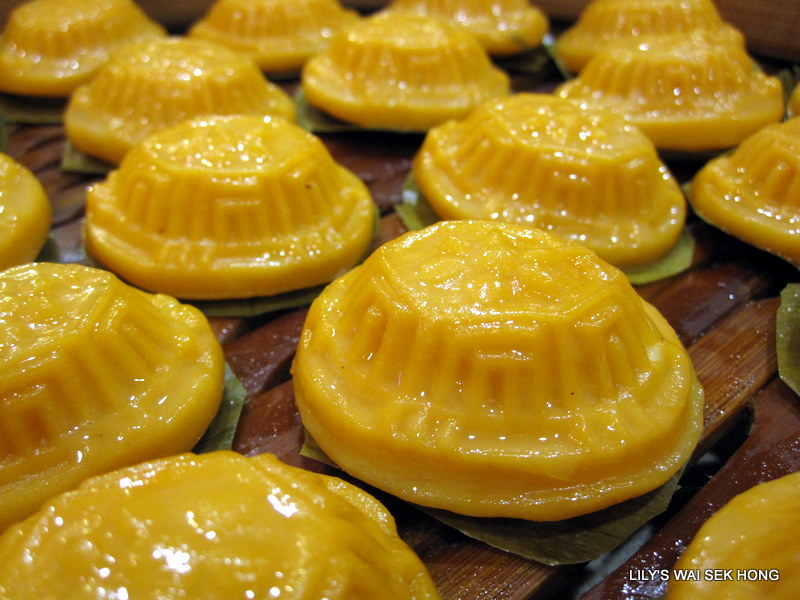
Taro Ku

When i was growing up, the only 'ku' i know was colored red or orange with a sweet filling.  Nowadays, 'ku' comes in all sorts of colors and shapes with either sweet or savory fillings.  Thank you to enthusiastic cooks who come up with new ideas which kick up a few knotches to the traditional this kuih.  Btw - 'ku' is in hokkien meaning Tortoise and Tortoise symbolizes longevity. When the 'ku'  kuih is shaped like a tortoise shell, it creates a high symbolic and ritual value, very appropriate for ritual offerings during religious events.  These 'ku' , it must be red in color and that is why it is called 'Angku' - 'Ang' means red in hokkien, is an important gift when a child is born (one month old) or during birthdays.  Outside the ritual or gift context, it is also a very popular snack, eaten at all times of the day, be it for breakfast or tea=time.    Have you ever tried pan-frying leftover/overnight 'Angku'? - they are delicious.

Below is a recipe with a new twist - Taro is added to the dough which gives the 'ku' a purplish hue and a fragrance which taro lovers will recognizeThe filling can be sweet or savoury and a spicy one will be met with satisfaction.


Ingredients:
For the Dough:

150 g taro slices - steamed and mashed(keep warm)
150 g glutinious rice flour
50 ml water(use only if the dough is too dry)
50 ml thick coconut milk
1/8 tsp salt
2 tbsp oil
Purple food coloring/taro paste
Extra glutionious rice flour for dusting
Pre-cooked cooking oil for glazing
Banana leaves - cut into rounds and brushed with oil

Filling of your choice or follow this sweet filling recipe

Method:

Sieve glutinious flour with salt.

Add oil and purple food coloring/taro paste to the thick coconut milk and microwave it for 30 seconds.

Add warm mashed taro to the glutinious flour and add in the coconut milk and oil a little at a time, knead until a dough forms.  Water is to be added only if the dough is too dry. Knead dough well until it is shiny. Rest the dough for 30 minutes.

Scale dough according to the size of your mould. 

Flatten dough and roll into a circle.  Put in some filling and wrap dough up.

Dust mould with glutinious flour and knock out all excess flour.

Press filled dough firmly into mould, knock and dislodge from mould.  Place on oiled banana leaf and into steamer rack.

Continue process with the rest of the dough pieces.

Turn on the tap on low and place steamer under the running water to remove excess glutinious flour from the surface of the moulded kuih.

Steam kuih over low heat for 10 minutes.  At 5 minutes, uncover the steamer to lower the temperature of the steam  cos the pattern will be lost if too high heat is used for steaming.  Cover and continue to steam until cooked.

Remove from heat and glaze surface with the precooked oil.


 Serves

Saturday, May 22, 2010

Horse's Hoof/Mah Keok

This is another spin-off from Hum Cheem Paeng.  This is a cousin of The Butterfly and Ox Tongue.  I have always thought that Horse's Hoof and Ox Tongue is the same but looking at the recipes for Ox Tongue,  i can see a difference.  Al;though the shape is the same, Ox Tongue has a sweet filling.  When i was back home last month, my dearest friend, Nancy, who still resides in Seremban, took me to the best YCK stall there and i stood there watching how YCK, Hum Cheem Paeng, Kap Chong and a new shape which i shall call = Seremban Butterfly were formed.  Forming all these were so easy for the stall owner and i would never imagine that they were done this way, if i had not watched him rolling, dusting and frying away.  I will have to do a batch of Seremban Butterfly before i forget how it is formed


Ingredients:

1 recipe of Hum Cheem Paeng II
Sesame seeds

Glaze:

1 tbsp all purpose flour
1 tbsp cornflour
3 tbsp sugar
60 ml water

Method:

Roll Hum Cheem Paeng dough into a 1/2 inch thickness rectangle with one side which is 8 inches.

Spread the glaze all over the rectangle and sprinkle sesame seeds on top.  Cover with cling-wrap and roll lightly over the sesame seeds so that it will adhere to the dough.

Fold the rectangle into half making a 4 inch side rectangle.

Cut into 1 inch slices and pinch the two ends to look like the Horse's Hoof.

Deep fry in moderately hot oil until golden brown.
Remove and place to drain on a  cake rack which is on top of a lined baking sheet.

Serves

Thursday, May 20, 2010

Chinese Doughnut With Glutinious Rice

I love glutinious rice and also Hum Cheem Paeng/Chinese Doughnut, so a combination of these two satisfy my craving at one go, how wonderful.  But, what are they called in chinese?  I thought it is called 'Kap Sum Choong'  but my dear friend, Peng, said it is called ' Kap Choong'.  I know that someone out there knows the name.  Help!!!!!


Ingredients:

1/2 recipe of Hum Cheem Paeng II
1 cup glutinious rice - soaked
2 tbsp sugar
1 tsp salt

Method:

Put the soaked glutinious rice, sugar, salt and enough water to come to just above the rice, in the rice cooker and cook rice until done.

Remove and let cool slightly.  While still warm, form into a log.

Roll the hum cheem paeng dough out into a rectangular shape, the length of the glutinious rice log, the width should be just enough to wrap up the glutionious log.  Pinch the seames tightly to seal.

Cut into 3/4  - 1 inch pieces and roll each piece out slightly and form them back into shape.

Dust away as much bench flour as possible before deep frying.

Deep fry on medium heat and keep turning hum cheem paeng for even browning.

Enjoy.

Serves

Saturday, May 1, 2010

Malaysian Satay (Sate)

Every time we have satay, i never have the opportunity to take a picture because it disappeared, devout as soon as they are off the grill. Fortunately, this time, 2 sticks and 2 pieces of cucumber were reserved for me. I was told that the word 'satay' is actually hokkien - 'sa' means three and 'tay' means pieces. That's why there are 3 pieces of meat in a stick.

Photobucket - Video and Image Hosting

Ingredients:

600 gm/1 1/3 lb beef , chicken or pork meat

Marinate:

10 small onions / shallots
5 cloves of garlic
2 inch long galanga /lengkuas
2 stalks lemon grass /serai
1 tsp pepper
3 tbsp kurma curry powder
1/2 tsp belacan powder(shrimp paste)
A teaspoon tumeric (kunyit)
4 tablespoons brown sugar
1 tsp dark soya sauce
1/2 tsp salt
2 tbsp oil or thick coconut milk

a bundle of 6 inch bamboo skewers
1 lemon grass(serai) - crush
oil/coconut milk for basting

Method:

Using the microplane, grate lengkuas and lemon grass.

Using the food processor, chop up the shallots and garlic. Add in the grated galanga ,lemon grass and the rest of the marinate.

Cut meat into 1/4 inch thick and 4 - 6 inch length.(with this length i will have 2 pieces to a skewer)

Marinate meat with the marinate for at least 2 hours.

Skewer meat with bamboo skewers.

Grill meat and using a crushed lemon grass as a brush, baste meat with oil/coconut milk.

Serve grilled meat with Satay sauce, cucumber and onions. Ketupat or Nasi Impit would be good but i stopped serving them as they are always not consumed and wasted all my effort to make them.

Satay Sauce:

1 lb raw peanuts - soak overnight in water and 2 tsp potassium carbonate & sodium bi-carbonate solution (for picture of bottle refer to Ban Jian Kuih).

1 packet of Chan Hong Instant Curry Assam Mix (available online at http://mytasteofasia.com/)

1/2 lb roasted peanuts - chopped fine

Drain peanuts and wash away the potassium carbonate & sodium bi-carbonate solution(kan sui) Steep in clean water for 1 hour.

Using the pressure cooker, cook peanuts in water for 15 minutes from hissing.

Remove some liquid (if you have used too much water to cook the peanuts as sauce should be thick ) and use a potato masher, mash the soft peanuts.

Add in the packet of instant mix and bring mixture to the boil.

Add in the roasted chopped peanuts.

Adjust the taste.

Chilly oil or sambal chilly can be added to sauce for additional spiciness.

Serves

Monday, April 26, 2010

Fish in Soya Sauce


Although i am happy that i get to see my siblings, relatives especially cousins who i seldom see when i was staying in Malaysia, and friends but it is so sad to see my mom, who is 84 and not well.  She is in the hospital with tubes and drips, all attached to her and i know she is in good care.  My mom has gone through alot bringing up 7 children and  she has never requested or demanded anything from her children.  Even now, in this situation, she will try to visit the restroom without asking for help.  When we were young, mom had to feed us with limited resources and frying fish and just sprinkling on soya sauce was the staple. 

Ingredients:

Fish - cleaned and rub with salt
Oil for shallow frying
Soya sauce

Method:

Heat wok/skillet (if it is teflon coated - do not heat), add oil and when oil is shimmering, slowly lower fish into oil.  Fry until brown before flipping over to brown the other side.  If fish should resist to dislodge, sprinkle a little salt oil into the oil and this will help.  Fish getting stuck is due to putting in the fry before the oil is hot enough. Use medium heat to fry fish if the fish is big and thick.

When fish is browned on both sides, remove to serving plate and sprinkle a tablespoon or two of soya sauce.

Serve warm or room temperature with white rice.


Serves

Thursday, April 8, 2010

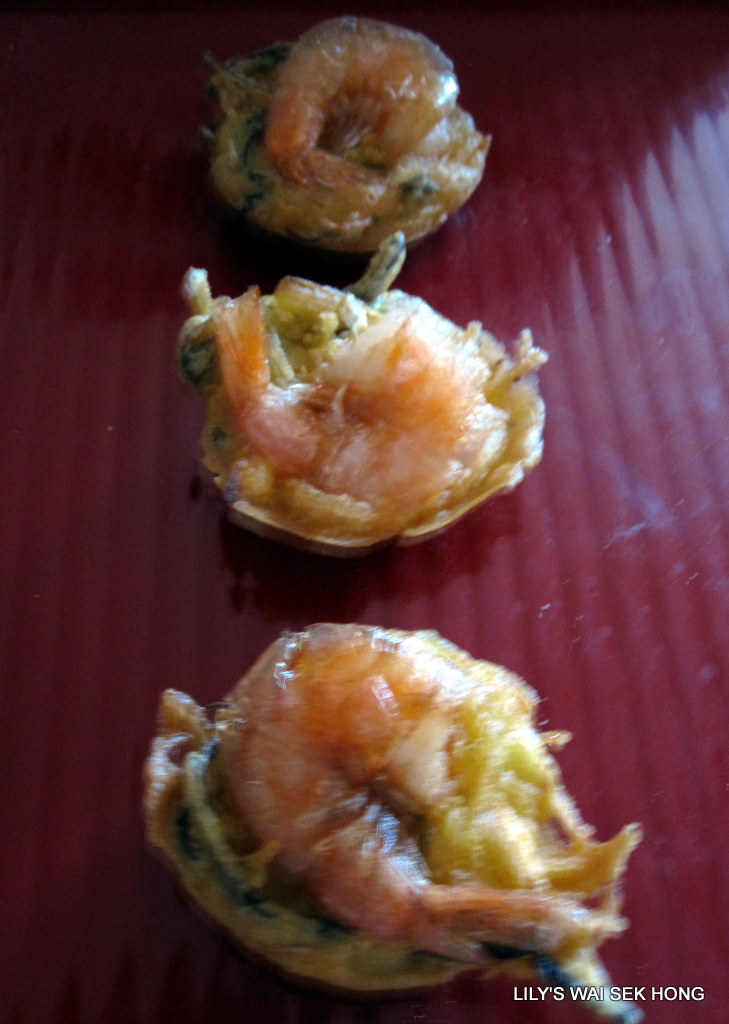
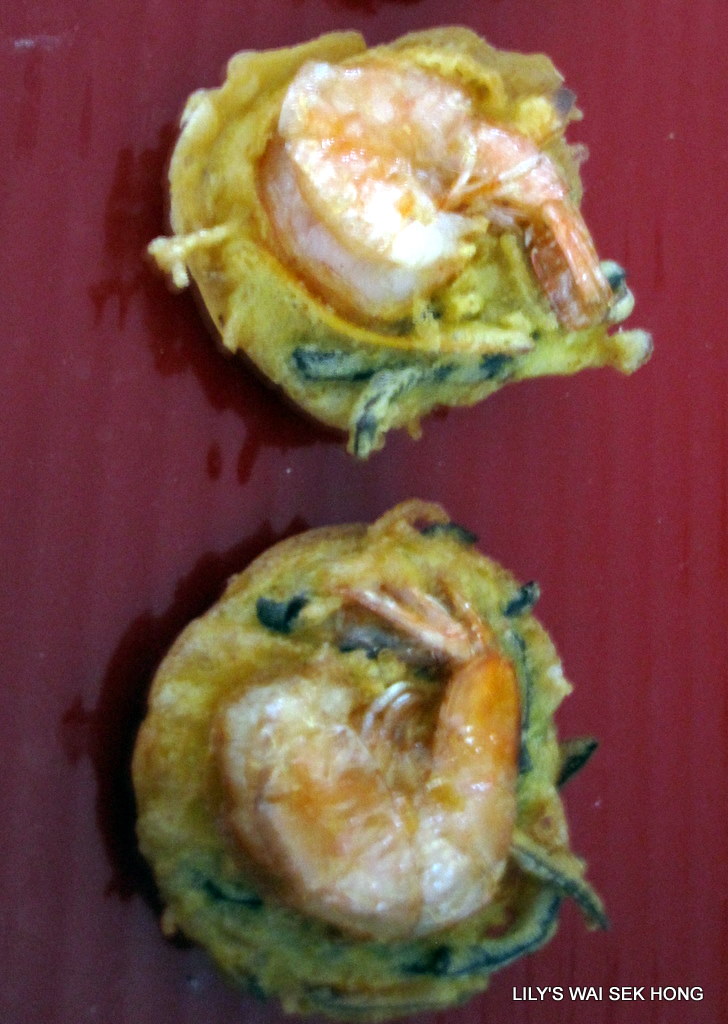
Cucur Udang/Malaysian Prawn Fritters


I have tried my recipes but did not like them cos either the batter was too thick making the fritters too doughy in the middle.  I like the fritters to be crispy all the way through with the vegetables not too soft.  The shrimp/prawn on top has to be fried crispy so that the shells can be eaten without getting choked on it.  For that reason, the shrimp/prawn has to be small.  The vegetables used do not have to be garlic chives and bean sprouts, i have used shredded potatoes, taro, pumpkin and i can go on and on, so play with your food and you can serve something that is so good that you yourself cannot imagine that it is possible.


Ingredients:

1 cup all purpose flour
1/2 cup tapioca starch
1/2 cup rice flour
1 tsp baking powder
1/2 tsp salt
 2 tbsp oil
1 tsp tumeric powder
1/2 tsp pepper
1/2 tsp chicken granules
1 cup water
1 1/2 cup bean sprouts
1/2 cup garlic chives - cut into 1 inch lengths
16 - 20 small shrimps
Oil for deep-frying

Method:

Combine the all-purpose flour, tapioca starch, rice flour, baking powder, salt, pepper, chicken granules and tumeric. and mix well.

Add water and oil to make a thin batter. Then stir in the chives and bean sprouts.

Heat the oil  in medium heat. Place a small ladle in the oil to and heat until ladle is hot.. Then lift the ladle out from the oil and allowing excess oil to drip off.

Using the chopsticks, pick up a bunch of vegetables together with as much batter as possible on to the hot ladle.  Put a piece of shrimp on to the center of the vegetables.and press it in. Lower the ladle into the oil,  when the base of the fritter has formed a crust, it will dislodged by itself if the ladle is hot enoughto begin with, if it does not fall off, gently push it out of the ladle with the tip of a spatula or small knife and allow it to continue frying in the oil until golden brown.

Repeat until all the vegetables in the batter are done.

Drain fritters on paper towel. Cool  slightly before serving with chilli sauce(recipe as follows)

Chilli Sauce

2 tbsp Siracha chilli sauce
3 tbsp tomato ketchup
1 tbsp sugar

Mix all the above ingredients.

Serves

Monday, April 5, 2010

Curry Puffs

How can anyone be tired of eating curry puffs?  To me, this is comfort food  and I will never refuse one even though i am packed full and looked like the curry puffs that are offered to me. They are the most delicious morsels that i ever ate, with  spicy curry paste for extra oomph and packed with soft potatoes, chicken/beef.   They are  deep fried to a guilty perfection with a crusty and crunchy exterior and to achieve this, the dough has to be rolled very thinly.   


Ingredients:

Pastry:

1 1/2 cups all-purpose flour
5 tbsp margarine/shortening
1/4 tsp salt
1/2 tsp baking powder
3 tbsp water


Filling:

1/2 lb chicken meat - dced
1 small onion - chopped
1 tbsp Garam Assam Paste
2 tbsp curry powder for meat
2 large potatoes - peeled and diced.
1 tsp salt
1 tbsp sugar
1/2 tsp black pepper
5 tablespoons oil

Oil for deep frying

Method:

To make the filling:

Heat oil and fry the chopped onions until sweat through. Add the garam assam paste, curry powder and saute until fragrant. Add the chicken, potatoes, and 1 cup water, cook until potatoes are fork tender.  Add salt and sugar to taste and cook until filling is dry.. Leave aside to cool.

To make pastry:

Using the food processor, add in flour, baking powder and salt, pulse to mix, then add margarine/shortening and pulse until it looked like breadcrumbs.  Add water and pulse until the dough is combined into a ball.. Let it rest for 1/2 hour.

Roll dough out into a long rope and cut into small portions.  Roll each portion into a very thin circle and put the filling in the center(amount of filling depends on the size of the circle). Fold pastry over to make a half circle and crimp the edges.

Deep fry in hot oil until golden.

Serves